

 Only The Stuff That Does Stuff
 Everything You Need In One Meal
 Stay Full For 3-5 Hours



What is the Yuka app?
Yuka is an app built to help you scan food and cosmetic products and quickly understand how they are rated. For food, it uses a 0 to 100 score based on nutritional quality, additives, and organic status, then turns that into color bands: dark green, light green, orange, and red. [1]
The nutritional quality part is based on Nutri-Score, a front-of-pack nutrition label developed by French public health researchers. [1] For cosmetics, the app does something similar with ingredient risk, where the single worst-rated ingredient can tank the final score. [2]
The stated goal is to help people make quicker, simpler choices in the supermarket or in the bathroom cabinet. That idea is good: most people do not have time to decode every label, and a fast summary can be helpful. But the problem starts when a shortcut begins to sound like the whole truth.
What Yuka does well
Credit where it’s due. Yuka succeeds at making ingredient lists more accessible. It gives shoppers a simple way to spot sugar, salt, saturated fat, and certain additives, which is useful if you're comparing two pasta sauces in aisle seven. It also nudges people to actually read labels instead of buying based on packaging alone.
That matters because food literacy is often low, and many consumers want a tool that translates technical information into something practical. [3] Used that way, Yuka can be a starting point, not a final answer.
Where it goes wrong
The main issue is that Yuka can oversimplify nutrition into a black-and-white story, creating fear instead of understanding. It often treats the presence of an ingredient as if it were automatically a problem, without enough attention to dose, context, or the role that ingredient plays in the final product.
That is a real issue because not all ingredients are there for the same reason. Some additives improve shelf life, texture, mineral content, or food safety. If an app scores a product down simply because it contains an additive, it can erase the benefit of a carefully formulated product that actually supports daily nutrition.
And here's a detail that matters a lot for products like ours: Nutri-Score (the system Yuka's nutritional scoring is built on) was never designed for meal replacements. Before this was widely communicated, we decided to add the Nutri-Score label to our products, as it seemed like the food industry was inevitably moving in that direction. At the time, all of our meals received an A rating. A few years later, though, we were informed that our products weren’t actually meant to be evaluated using the Nutri-Score system.This can be confirmed on the official Nutri-Score FAQ where it explicitly states that "meal replacement products, which do not have a goal of weight control, are also not eligible for the application of the Nutri-Score." [4] Foods for special medical purposes, sports nutrition, and food supplements are all excluded too.
So when Yuka applies a Nutri-Score-derived calculation to a complete meal product, it's using a ruler that was never built for the job.
Additives are not the enemy
A lot of the controversy comes from the way Yuka presents additives. The app can imply that “chemical” means “bad,” which is not how food science works. In reality, safety depends on the ingredient, the dose, and the total exposure. Toxicologists have been saying "the dose makes the poison" since the 16th century. [5] It's still true.
This taps into a well-documented cognitive bias called the "appeal to nature" fallacy: the assumption that natural substances are inherently safer than synthetic ones. Research in Behavioral Scientist found that 70% of participants chose a drug labelled "natural" over an identical synthetic option. And 20% still chose the natural version even when it was reported to be less safe. [6]
That bias is powerful, and apps like Yuka can amplify it. When a product with strong macros, complete micronutrients, and controlled portions scores worse than a less balanced product because of one additive, something's off.
Bread is chemistry too
People see bread as simple and natural. But bread contains water, starch, proteins like gluten, sugars formed during baking (Maillard reaction), salt, yeast-derived compounds, organic acids, and dozens of other molecules created or transformed during processing. [7] That does not make bread bad. It just means food is chemistry, whether we like the word or not.
The fear around ingredients often comes from language, not from actual risk. See an unfamiliar compound on a label? Easy to assume it’s dangerous. The formal term for this is “chemophobia”, and it influences consumers behaviour far more than actual toxicological evidence. [8]
Science gets flattened
Yuka’s scoring system can make it seem like food is either good or bad, when in reality nutrition is about patterns, quantity, and context. A product can be highly useful because it contains protein, fibre, healthy fats, and a meaningful share of vitamins and minerals, even if it includes one regulated ingredient that the app dislikes.
That’s especially relevant for functional foods and meal replacements. These products are not supposed to look like a banana or an apple. They are designed to deliver complete nutrition in a controlled format. Judging them by a single additive misses the entire point. They fall under specific EU legislation (Regulation 609/2013) precisely because they serve a different nutritional purpose.[9]
Let’s see what Yuka says about our meals

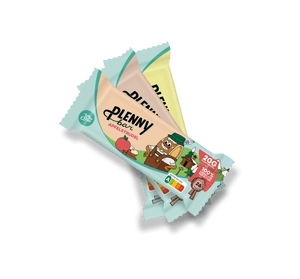
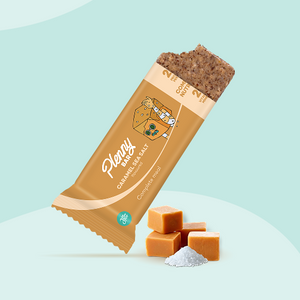
In Yuka, the Plenny Bar Caramel Sea Salt gets a score of 49/100 and is marked "poor." The app flags it as "a bit too caloric" at 400 kcal per 100 g and "a bit too much sodium" at 1.05 g salt per 100 g.
Sounds concerning until you remember this is a meal, not a snack.
400 kcal is not excessive for a meal. Divide a standard 2,000 kcal day across three main meals and two smaller eating moments, and 400 kcal per meal is right in range.[10]
As for 1.05 g salt in a full meal: that's roughly one-fifth of the WHO's recommended daily limit of under 5 g.[11] For context, the global average sodium intake is already more than double the WHO recommendation.[11]
The issue isn't that calories or salt should be ignored. The issue is that Yuka presents them without context about intended use. A bar designed to replace a meal should be assessed differently from a chocolate bar eaten on top of your lunch.
Now let’s see how the ingredients are classified. Yuka shows the regulatory classification of an additive without explaining how it's actually used in the product. That leads to some pretty misleading labels.

Glycerol (E422) shows up as a "texturising agent" with "limited risk." Also not the full story. Glycerol helps bind ingredients, maintain low water activity, and keep products shelf-stable. EFSA's follow-up opinion focused on refining impurity specs and raised no safety concerns about glycerol itself. [15] Moreover, a 2026 EFSA opinion on acute glycerol exposure from beverages reached the same conclusion. [16]
Calcium carbonate (E170) is labelled "food colouring." Technically, E170 sits in the colourants category of the EU additive register.[12] But it's also an authorised source of calcium, and EFSA concluded there's no need for a numerical ADI (Acceptable Daily Intake) because there's no safety concern at current use levels. [13,14] We use it to provide calcium. Calling it "food colouring" misdescribes the nutritional purpose.
The same pattern repeats across several micronutrients. Riboflavin shows as E101 "food colouring" (it's vitamin B2). Ascorbic acid shows as E300 "antioxidant" (it's vitamin C). Alpha-tocopheryl acetate appears as E307c "antioxidant" (it's vitamin E). Niacin is E375, potassium chloride is E508 "anticaking agent." They're there to supply vitamins and minerals.
EU law requires additives to be declared by functional category on the label.[12] That's fine. But functional category and nutritional purpose are not the same thing. When Yuka shows only the E-number label without explaining why the ingredient is there, a science-based formulation ends up looking suspicious. That's one of the app's biggest communication failures.
Lastly, sucralose and fear-based framing. Yuka classifies sucralose (E955) as "high-risk" and links it to suspected carcinogenicity, cardiovascular disease, type 2 diabetes, gut microbiota disturbance, and overweight. That's a heavy list. 


Here's what science actually says.
In February 2026, EFSA published its most comprehensive re-evaluation of sucralose in over two decades. Conclusion: no need to change the ADI of 15 mg per kg body weight per day. EFSA stated that "sucralose continues to be safe for consumers for its currently authorised uses" and that current exposure stays below that level. [17,18] The review covered toxicological studies, epidemiological data, and scientific literature from 1999 to 2025.[17]
Some observational research does find associations between sweetener consumption and certain health outcomes. But association is not causation. People who consume more low-calorie sweeteners may already differ in weight, dietary habits, or metabolic risk, which makes simplistic causal claims unreliable.[19]
For many consumers, sucralose is simply a tool to reduce sugar intake while keeping things tasty. Labelling it "high-risk" when the EU's own food safety authority just reconfirmed its safety at current use levels is, at best, misleading.
The bigger scientific problem
The issue with Yuka isn't about one sweetener or one mineral salt. It's a communication pattern: the app implies "natural" is good and "chemical" is bad, even though all food is chemicals. Your morning coffee contains over 1,000 chemical compounds. An organic apple contains formaldehyde, acetaldehyde, and trace amounts of hydrogen cyanide, all naturally occurring, all perfectly safe at those doses. [5]
A fortified meal product is built differently from a whole apple because it's trying to do something different. It's engineered to deliver balanced macros, micros, and fibre in a format that's convenient, shelf-stable, and nutritionally predictable. If an app collapses all of that into a colour-coded moral ranking, it may push consumers away from products that are actually useful, safe, and well designed.
A better way to use it
The best way to frame Yuka is as a guide, not a judge. It can help people start asking better questions about ingredients, processing, and nutrition. That is useful.
For food, try asking: is this a meal or a snack? What does it contribute in protein, fibre, fats, vitamins, and minerals? How does it fit into my overall diet? Is the additive actually doing something useful here?
For cosmetics, look at efficacy, safety assessment, and product purpose, not just whether an unfamiliar compound appears on the label.
Wrapping it up
Yuka has a good intention: it wants to help consumers understand what they buy and make better choices. But its simplified approach can leave out a lot of information, and that can lead to miscommunication toward the customer. It is useful as a starting point, but it is not a substitute for science or context.
Instead of helping people make better-informed choices, the app can sometimes create fear around “chemicals,” punish useful additives, and erase the benefits of smart formulation.
A helpful starting point? Yes. A replacement for science, nutrition context, or critical thinking? No.
Food science and Nutrition are constantly advancing, and we continue to monitor with great care to deliver the healthiest meal possible. Check out our sources below if you’re curious and want to dive in yourself.
References
1. Yuka. How are food products rated? Available from: https://help.yuka.io/l/en/article/ijzgfvi1jq-how-are-food-products-scored
2. Yuka. About Yuka: food and cosmetic product scanner. Available from: https://yuka.io/en/
3. Campos S, Doxey J, Hammond D. Nutrition labels on pre-packaged foods: a systematic review. Public Health Nutr. 2011;14(8):1496–506. Available from: https://pubmed.ncbi.nlm.nih.gov/21241532/
4. Nutri-Score Scientific Committee. Nutri-Score: Questions & Answers. Available from: https://www.blv.admin.ch/dam/blv/de/dokumente/lebensmittel-und-ernaehrung/ernaehrung/nutri-score-fragen-antworten-en.pdf.download.pdf/QR_scientifique_technique_EN_011119.pdf
5. Ottoboni MA. The Dose Makes the Poison: A Plain-Language Guide to Toxicology. 3rd ed. Hoboken: Wiley; 2016.
6. Deleniv S, Ariely D, Peters K. "Natural Is Better": How the Appeal to Nature Fallacy Derails Public Health. Behavioral Scientist. 2022. Available from: https://behavioralscientist.org/natural-is-better-how-the-naturalistic-fallacy-derails-public-health/
7. Cauvain SP, Young LS. Technology of Breadmaking. 3rd ed. Cham: Springer; 2015.
8. Michigan State University Center for Research on Ingredient Safety. Chemophobia: Fearing Chemicals. Available from: https://cris.msu.edu/news/chemophobia/chemophobia-fearing-chemicals
9. Regulation (EU) No 609/2013 of the European Parliament and of the Council of 12 June 2013 on food intended for infants and young children, food for special medical purposes, and total diet replacement for weight control. Available from: https://eur-lex.europa.eu/eli/reg/2013/609/oj
10. EFSA Panel on Dietetic Products, Nutrition and Allergies. Scientific Opinion on Dietary Reference Values for energy. EFSA Journal. 2013;11(1):3005. Available from: https://efsa.onlinelibrary.wiley.com/doi/10.2903/j.efsa.2013.3005
11. World Health Organization. Sodium reduction: fact sheet. Available from: https://www.who.int/news-room/fact-sheets/detail/sodium-reduction
12. Regulation (EU) No 1169/2011 of the European Parliament and of the Council of 25 October 2011 on the provision of food information to consumers. Available from: https://eur-lex.europa.eu/legal-content/EN/TXT/?uri=CELEX%3A32011R1169
13. EFSA Panel on Food Additives and Nutrient Sources added to Food. Scientific Opinion on re-evaluation of calcium carbonate (E 170) as a food additive. EFSA Journal. 2011;9(7):2318. Available from: https://efsa.europa.eu/en/efsajournal/pub/2318
14. EFSA Panel on Food Additives and Flavourings. Re-evaluation of calcium carbonate (E 170) as a food additive in foods for infants below 16 weeks of age and follow-up of its re-evaluation as food additive for uses in foods for all population groups. EFSA Journal. 2023;21(7):8106. Available from: https://efsa.onlinelibrary.wiley.com/doi/10.2903/j.efsa.2023.8106
15. EFSA Panel on Food Additives and Flavourings. Follow-up of the re-evaluation of glycerol (E 422) as a food additive. EFSA Journal. 2022;20(6):7353. Available from: https://efsa.onlinelibrary.wiley.com/doi/10.2903/j.efsa.2022.7353
16. EFSA Panel on Food Additives and Flavourings. Safety of acute exposure to the food additive glycerol (E 422) from beverages. EFSA Journal. 2026;24:10057. Available from: https://efsa.onlinelibrary.wiley.com/doi/10.2903/j.efsa.2026.10057
17. EFSA Panel on Food Additives and Flavourings. Re-evaluation of sucralose (E 955) as a food additive and evaluation of a new application on extension of use of sucralose (E 955) in fine bakery wares. EFSA Journal. 2026;24(2):e9854. Available from: https://efsa.onlinelibrary.wiley.com/doi/10.2903/j.efsa.2026.9854
18. EFSA. EFSA finds sucralose safe when used as currently authorised; cannot confirm safety of extending its use. 17 February 2026. Available from: https://www.efsa.europa.eu/en/news/efsa-finds-sucralose-safe-when-used-currently-authorised-cannot-confirm-safety-extending-its
19. Azad MB, Abou-Setta AM, Chauhan BF, et al. Nonnutritive sweeteners and cardiometabolic health: a systematic review and meta-analysis of randomized controlled trials and prospective cohort studies. CMAJ. 2017;189(28):E929–E939. Available from: https://pubmed.ncbi.nlm.nih.gov/28716847/


 Product added to cart